How star collisions create cosmic monsters
Building giant stars
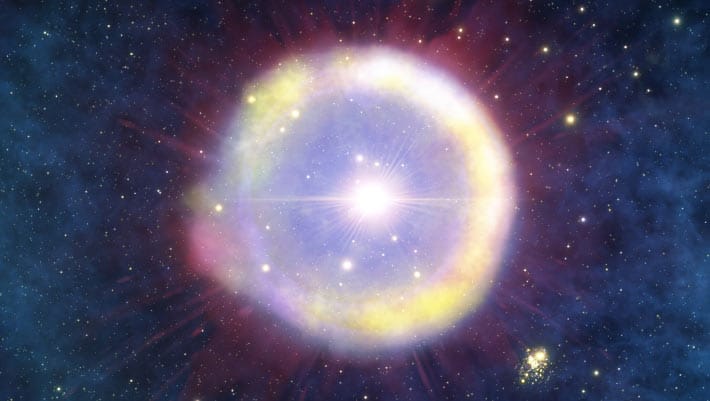
In the early universe, stars lived in extremely crowded neighborhoods. New research suggests that in these dense clusters, stars frequently bumped into each other. Instead of exploding, these stars often merged, growing into "very massive stars"—giants that can be over 200 times heavier than our Sun.
From collisions to black holes
When these massive stars reach the end of their lives, they can collapse under their own weight to form black holes (regions of space where gravity is so strong that not even light can escape). In the most extreme cases, repeated mergers can create a single object so heavy it rivals the mass of an entire star cluster, eventually forming a supermassive black hole.
Solving the mystery of 'Little Red Dots'
This process may explain the mysterious "Little Red Dots" (LRDs) recently spotted by the James Webb Space Telescope. These are compact, reddish objects that appear to be very dense.
Researchers found that when a black hole is already present, its intense gravity causes stars to crash into each other violently rather than merging. This destruction shreds the stars, creating a thick, dense cloud of gas around the black hole. This cloud acts as a fuel supply, giving these objects their unique, glowing red appearance.
By connecting these stellar smash-ups to the formation of black holes and LRDs, scientists are finally getting a clearer picture of how the early universe grew its first giants.