Hubble Spots a Dusty Galaxy Seen Sideways
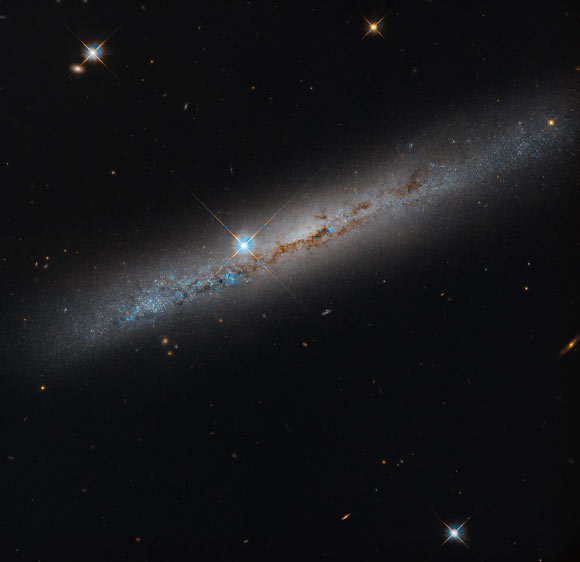
The Hubble Space Telescope has taken a stunning new picture of a galaxy called NGC 1827.
This galaxy is about 37 million light-years away from us. That means the light we see from it today started its journey 37 million years ago! It's located in the southern sky, in a constellation named Columba.
NGC 1827 is a type of galaxy called a spiral galaxy, and we're seeing it edge-on, like looking at a frisbee from the side.
The new image shows bright blue areas in the galaxy's disk. These are likely places where new stars are being born. You can also see dark lines of dust mixed in. Dust clouds are like the nurseries for stars.
There's also a bright star in the foreground, closer to us than the galaxy. Its pointy spikes are just an effect of how Hubble's camera works.
This picture is part of a bigger project where Hubble is looking at many smaller galaxies that orbit larger ones, like our own Milky Way. Scientists study these smaller galaxies to test their ideas about how the universe works on a smaller scale.