Distant Cosmic Flash Found: A Clue to Early Star Birth
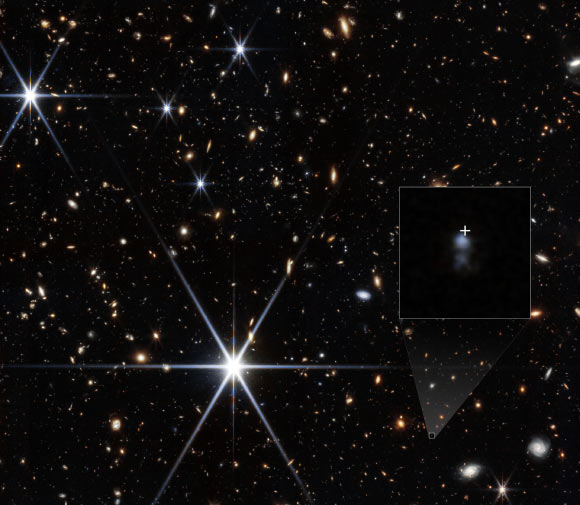
Astronomers have detected a Fast Radio Burst (FRB) that's the farthest away ever seen. These bursts are super-short, powerful flashes of radio waves from space, and we're still not sure exactly what causes them.
This particular burst, named FRB 20240304B, traveled for over 10 billion years to reach us. That means we're seeing it as it was when the universe was very young, only about 3 billion years old. This is a new record for how far back in time we've seen an FRB.
Scientists used the powerful James Webb Space Telescope to find the galaxy where this burst came from. It was too faint for other telescopes to see.
The galaxy is small and is busy making lots of new stars. This discovery supports a leading idea that some FRBs might come from magnetars. These are a type of super-dense star, called a neutron star, that has an incredibly strong magnetic field. They are often born in massive star explosions.
The finding helps us understand more about these mysterious bursts and the early universe.