Astronomers find two giant black holes in the early universe
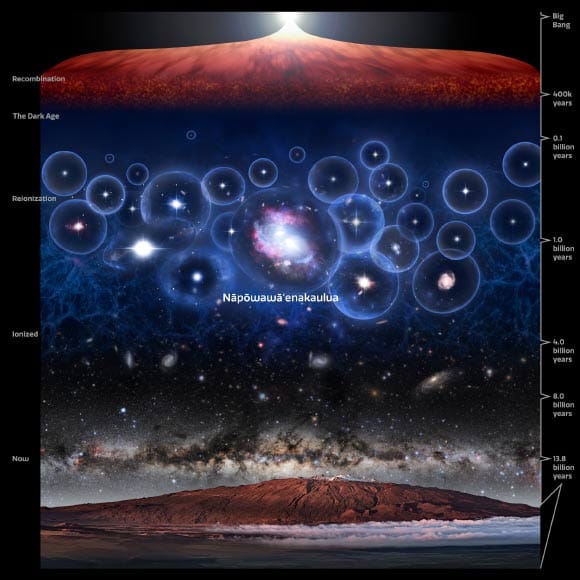
Astronomers have discovered a rare pair of quasars—extremely bright, active centers of galaxies powered by supermassive black holes—located in the very early universe. Named Nāpōwawāʻenakaulua, this pair is separated by only 18,100 light-years, which is about one-fifth the width of our own Milky Way galaxy.
A cosmic mystery
These two black holes are massive, weighing 1.5 billion and 400 million times the mass of our Sun. They were spotted as they existed just 900 million years after the Big Bang, a time when the universe was still in its infancy.
Finding such large black holes so early in cosmic history is a surprise. Current scientific models struggle to explain how they could have grown so big, so quickly. Researchers believe this pair formed in a region where matter was incredibly dense, causing galaxies to crash into each other and fuel the rapid growth of these black holes.
Why it matters
Because these objects are so old and close together, they act as a natural laboratory. By studying them, scientists hope to better understand how the first massive galaxies and their central black holes were built during the "cosmic dawn," the period when the first stars and galaxies began to light up the dark universe.