Uranus and Neptune: Ice Giant 'Twins' Actually Had Very Different Pasts
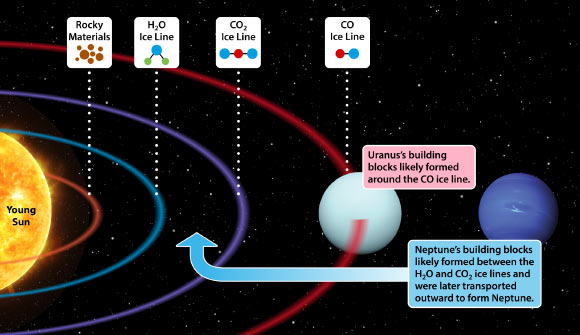
Uranus and Neptune look like near-twins from afar, but new research reveals they are more like distant cousins. Their inner chemistry suggests they grew up in completely different parts of the early solar system.
Because NASA's Voyager 2 spacecraft only flew by them once in the 1980s, scientists still know very little about what lies deep inside these ice giants (planets made largely of heavier elements like water, ammonia, and methane rather than just hydrogen and gas).
To look beneath their cloudy tops, researchers used carbon monoxide—a common gas detected in their upper atmospheres—as an indirect clue. By tracing how this gas moves up from deep within the planets, scientists can calculate how much oxygen and carbon are hidden far below.
Different Neighborhoods in Space
By comparing these chemical fingerprints to models of the protoplanetary disk (the vast, spinning cloud of gas and dust around the young Sun where planets formed), the team found a big mismatch between the two worlds:
- Neptune has far more oxygen relative to hydrogen than Uranus does, and its chemical makeup does not match where it currently sits.
- Uranus likely formed from materials closer to its current home, while Neptune's building blocks likely traveled a much longer journey from closer to the Sun before clumping together.
Why This Matters
Planets the size of Uranus and Neptune are extremely common around other stars in our galaxy. Understanding these two ice giants helps astronomers figure out how planets form everywhere. This is a major reason why scientists are pushing for a dedicated NASA mission to visit Uranus in the coming decade.