James Webb Space Telescope Reveals Dusty Ice Inside an Interstellar Comet
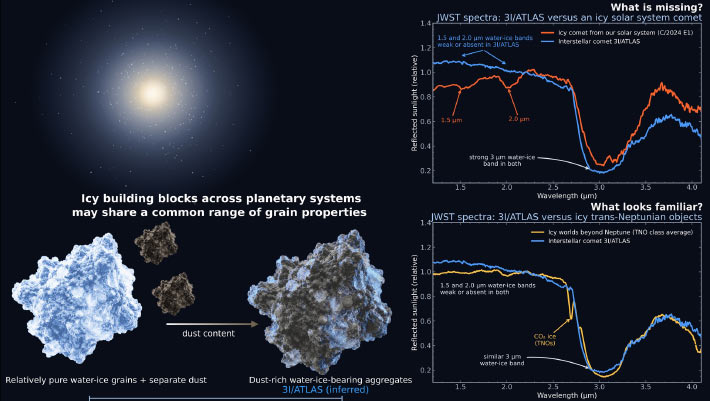
Astronomers using the James Webb Space Telescope have taken a close look at 3I/ATLAS, a visitor comet from another star system. They discovered that its water ice is tightly packed with tiny grains of dark, rocky dust.
A Visitor from Afar
Comets are icy wanderers left over from the birth of planetary systems. While most comets in our solar system feature relatively pure chunks of ice, 3I/ATLAS is different. As the comet neared the Sun, it warmed up and released gas and dust into a fuzzy cloud around it, allowing telescopes to read its chemical signature.
Researchers found that the microscopic ice grains in 3I/ATLAS are heavily mixed with rocky materials. Curiously, this dusty blend looks less like local comets and more like the icy worlds that orbit the Sun far beyond Neptune.
Clues to Alien Planetary Systems
This discovery suggests that the building blocks of planets might form in similar ways across different star systems. The tiny, dust-filled ice grains found in 3I/ATLAS hint that the way water ice mixes with rocky dust in planet-forming disks could be a universal process, offering astronomers a rare peek into the chemistry of distant star systems.