Webb telescope watches two stars collide in Andromeda
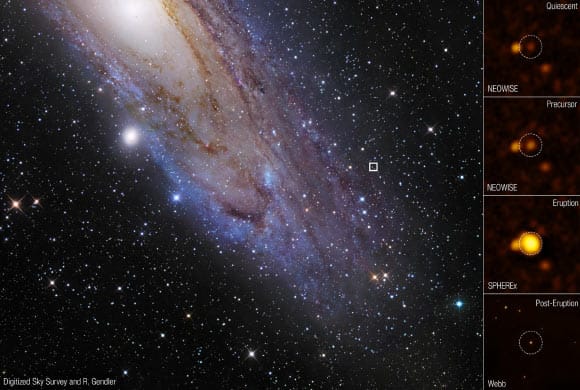
Astronomers have witnessed a rare cosmic event: a small star spiraling into a massive, bloated neighbor and merging with it. This collision took place in the Andromeda galaxy and was captured by the James Webb Space Telescope.
A rare stellar merger
Usually, when two stars orbit each other and begin to merge, the process takes thousands of years. In this case, nicknamed "Bao," the two stars crashed together in just seven years. This is the first time scientists have been able to track such a merger in real time from start to finish.
Why it matters
By observing the system only 47 days after the stars erupted, researchers gained a clear view of how the two objects became one. The smaller star was about 70% the mass of our Sun, while the larger star was a massive supergiant—a star in its final, puffed-up stage of life.
During the crash, the system ejected a cloud of gas and dust into space. Scientists believe this merger might actually "rejuvenate" the resulting star, potentially changing its lifespan and brightness. This discovery helps experts better understand how stars interact and evolve when they are trapped in a shared orbit.