A rare triple star system found just 27 light-years away
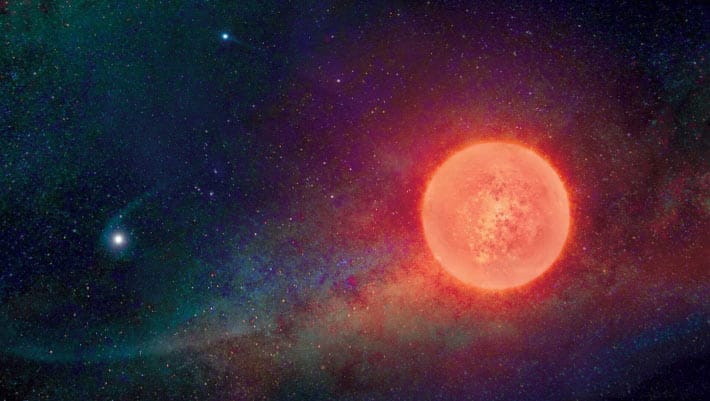
Astronomers have discovered a rare "triple system"—a group of three stars orbiting one another—located only 27.6 light-years from Earth. Named Welopō‘ai, the system consists of two white dwarfs (the dense, cooling cores of dead stars) and one red dwarf (a small, cool, long-lived star).
A surprise discovery
Researchers from the Université de Montréal were originally using the Canada-France-Hawai’i telescope to hunt for planets around the red dwarf. They noticed the star wobbling in a way that was far too strong to be caused by a planet. Follow-up observations confirmed the culprit was a hidden white dwarf orbiting the red dwarf every 9.8 years.
Why it puzzles scientists
This system is unusual for several reasons:
- The survival mystery: When the inner white dwarf was still a normal star, it should have expanded into a giant and swallowed its neighbor. Instead, the red dwarf survived, perhaps thanks to the gravitational influence of the second, more distant white dwarf.
- The age conflict: The white dwarfs suggest the system is 9 to 11 billion years old, yet the red dwarf contains high levels of metals, which is typically a sign of a much younger star.
- Potential debris: Scientists detected a faint infrared glow, which could indicate a debris disk—a ring of dust and rocky fragments left over from the star's evolution—though this needs further study.
Researchers are calling the system a cosmic puzzle, as it defies current models of how stars evolve. Future observations with space telescopes will help determine how this unlikely trio managed to stay together.